He pulls a bunch of envelopes from the mailbox. Invitations, bills, junk mail….
But one postcard makes his hands shake with excitement.
Sender: Chaim Kanievsky, Rashbam 23, Bnei Brak
A few weeks ago, he sat down and wrote out a question, like he did on occasion. He sent the letter and waited eagerly for a response, an envelope with a small piece of paper bearing a short answer, or maybe even a postcard with a few small, but meaningful, words. A Torah giant, a great Gaon, a Gadol HaDor corresponds with him.
But this time, he turns the postcard over and realizes that there must be a mistake. The postcard…is blank.
He turns it over repeatedly. Perhaps he missed some words on the front, or maybe something’s scrawled in the corner? But no, the postcard is blank. He can’t find a single letter or word to answer his question. Why would the great Gaon mail a blank postcard? Perhaps it was mistakenly inserted into the pile of letters waiting to be mailed out, after all, a lot of Yidden send their questions to this address in Bnei Brak.
The next time he’s in Bnei Brak, he joins the line at the entrance to Maran Sar HaTorah’s house. This took place years ago, when the line wasn’t long enough to reach the street yet. Once inside, he pulls the postcard from his pocket and asks why he hadn’t merited an answer.
“What was your question?” Maran HaGaon Rav Chaim asks in a tone that indicated that he well remembers the question.
“I asked,” the Yid replies, “If we write חיים orחים , with one or two yuds.”
Rav Chaim smiles, “What does it say on the postcard?”
The Yid looks back at the postcard and smiles widely. When Rav Chaim wrote his name as the sender, he already answered the question, as Beis Shmuel writes about the name: חיים.
The blank postcard tells the story. Maran Sar HaTorah, who learned Torah non-stop and whose every minute was more precious than gold and silver, was curt and concise in speech and when writing his teshuvos. He even used the abbreviated בו”ה when giving brachos, instead of taking the time to say ברכה והצלחה. And if he could answer a question without writing a word or letter, he simply didn’t write them….
But, still, every single day, he dedicated his precious time to answering questioners of every age and in every situation.
The Day Will Yet Come
Since he was a young child, the ‘pen’ was Rav Chaim Kanievsky’s good friend. Yearning to write a sefer of chiddushei Torah, he collected a few ideas, wrote them down in his childish handwriting, and, like talmidei chachamim who authored seforim, took his sefer to his uncle, the Chazon Ish. Sia”ch HaSadeh was the title he gave to his first notebook. The Chazon Ish read the name of the “sefer,” and finished off the pasuk with a thin smile, Terem Yitzmach – hasn’t sprouted yet. Later on, Rav Chaim would give this same title to one of his amazing series of seforim.
The little boy didn’t flinch. Again, he opened a notebook and filled it with his ideas. This time, he wrote down the names of Tannaim and Amoraim, including some names conceived by his childish misunderstanding. (For instance, a sentence like Amar Rav ganav mishalem keren could turn into an Amora named “Rav Ganav.”) This time the boy enthusiastically wrote the title of his sefer on the first page of the notebook: קודש קדשים.
The Steipler, who knew his son well and realized that he could withstand criticism, let him know what he thought about the title by delicately erasing the edges of the letter daled. Now the notebook was named Keresh Kersashim – קרש קרשים.
Despite this jab, the Steipler encouraged his son to continue writing, knowing that one day this little boy would illuminate the eyes of Klal Yisrael with his many seforim. He always encouraged talmidei chachamim to publish their seforim. He would often bemoan the fact that a certain gadol of the previous generation, someone who led many kehillos and was a prominent posek, never printed his manuscripts. Over the years, dozens of cartons full of his chiddushim and manuscripts were lost and the only Torah remaining from him is a small mention in Sha’ar HaTziun. Back when he was young, Rav Chaim would already daven that Hashem give him the merit of writing a lot of seforim.
The little child turned into a boy, then became a bachur and turned into an averich. No matter what others said or thought, he didn’t stop learning, not even for a minute. He learned and learned and learned and wrote. “If I would pay attention to every comment I hear,” he once told his son, “I wouldn’t have written even one sentence my entire life.”
Once, while answering critiques of his seforim, comments and remarks that he enjoyed receiving so he could make corrections when necessary, he said, “One day people will know my seforim and learn from them.” The questions and comments he received were clear proof that his seforim were being studied by many people, but his modesty prevented him from realizing how popular his seforim had become.
When he finally printed his seforim, the fruits of his labor, his spiritual treasures, he would literally stroke and pat the seforim and caress them. From a young age, his family was taught how to organize and sweep the “cheder seforim,” his study. In a home that had a special brush for cleaning the seforim, even a crumb of a page from a sefer was treated royally.
The honor he displayed for seforim generated supernatural events.
Once, the ancient kerosene heater next to the bathroom burst into flames when Rav Chaim was deep in learning with his chavrusa, HaGaon HaRav Berel Weintraub (son of HaGaon HaRav Shmuel Weintraub, Rosh Yeshivah Novardok, where the Steipler had taught). The fire spread quickly, consuming the house and everything in it. It took a few minutes until the screams and yells tore the chavrusas away from their gemaras and they realized what was happening. At the very last minute, they jumped out of the house and their lives were saved.
But, suddenly, they noticed something strange. Right in front of the bookcases, which were crammed with seforim, flammable material, the fire stopped, as if blocked by an invisible obstruction. “This was a condition that Hashem made in ma’aseh Bereishis,” the Ohr HaChaim Hakaodesh wrote, “that it should be subservient to Torah and those who study it. That it should follow their commands.”
The incredible sight amazed the non-Jewish workers who repaired the house after the fire. The fire was too scared to confront Rav Chaim’s bookcase. But the miracle was even greater. Rav Chaim kept his manuscript of Derech Emunah in another room, which had been completely destroyed by the fire. Just a few hours previously, Rav Chaim handed his manuscript to Rav Dov Landua shlita so that he could review it.
Rav Chaim stood in front of the blackened, sooty house, thanking Hashem for pouring out His anger on sticks and stones, and joyfully said, “The Derech Emunah was saved.”
The profound reverence for every scrap of paper with divrei Torah was also what led Rav Chaim to preserve the amazing treasure that is now being revealed for the very first

Standard Answers
23 Rashbam Street
The address we’re so familiar with and the home that was visited by thousands of people still stands, but without its spirit. The rooms that were once crowded with Yidden…The walls permeated with his Torah…. His bookcases.
Now everything looks so pale. Lifeless. The heart is missing.
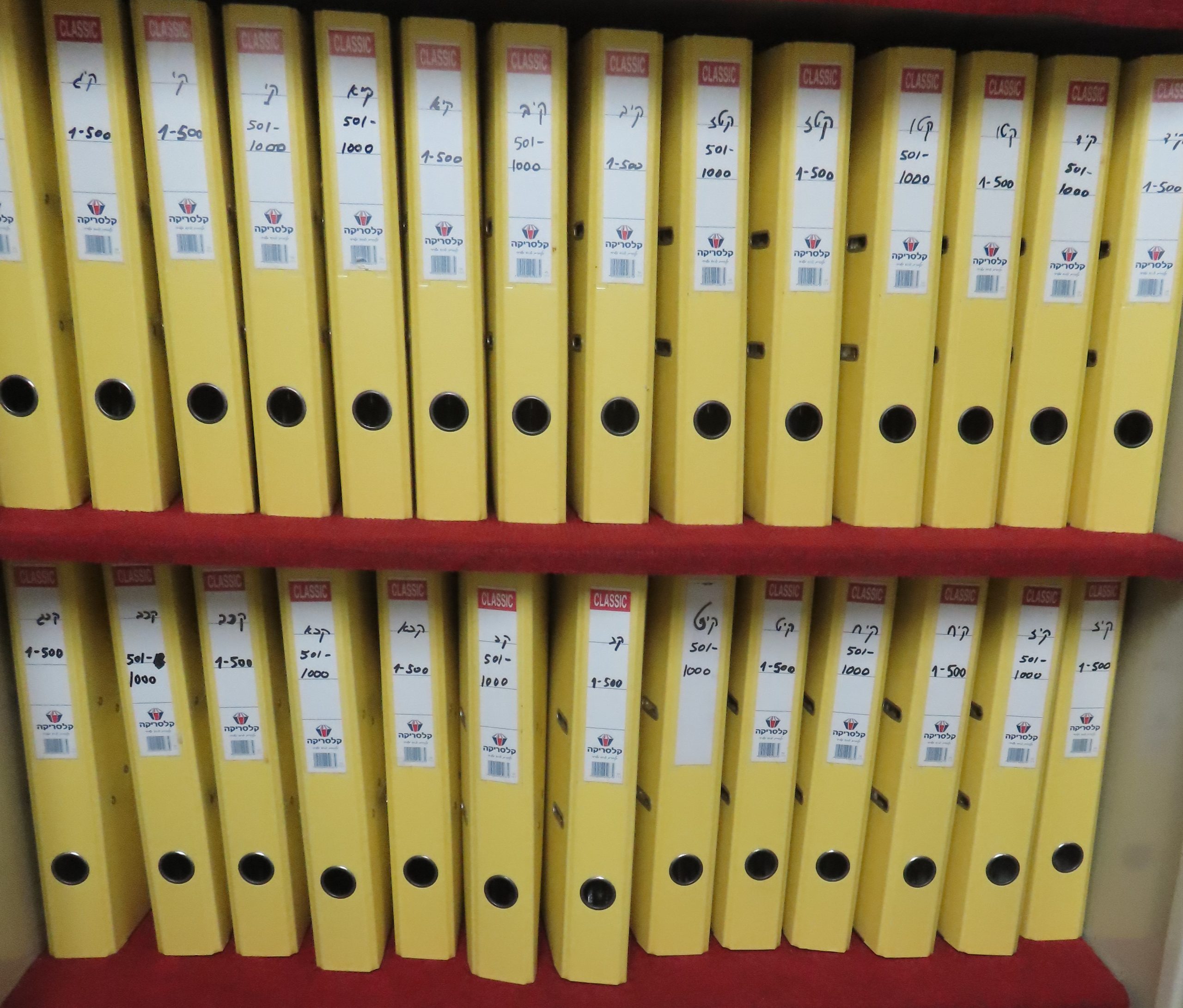
But not too far away, in a few safe places, we will soon merit to see a secret treasure: The full scope of the teshuvos of Maran Sar HaTorah. A quick calculation tells us that there are millions (!) of teshuvos in this storehouse and in other places.
“I organized the letters over many years,” Rav Chaim had said. “I thought they would be reorganized and used to make a sefer. Now my son, Rabbi Yitzchak Shaul shlita, is publishing the letters in Daas Noteh. Avreichim are doing a good job of organizing them.”
Three years after Rav Chaim’s passing, when the tenth volume of Daas Noteh is being published, we are allowed in to the “holy of holies” where these treasures are kept.
Our hearts skip a beat. There is no other place in the world like this, and this is the first time it’s being opened like this.
A giant archive with decades of questions and answers.
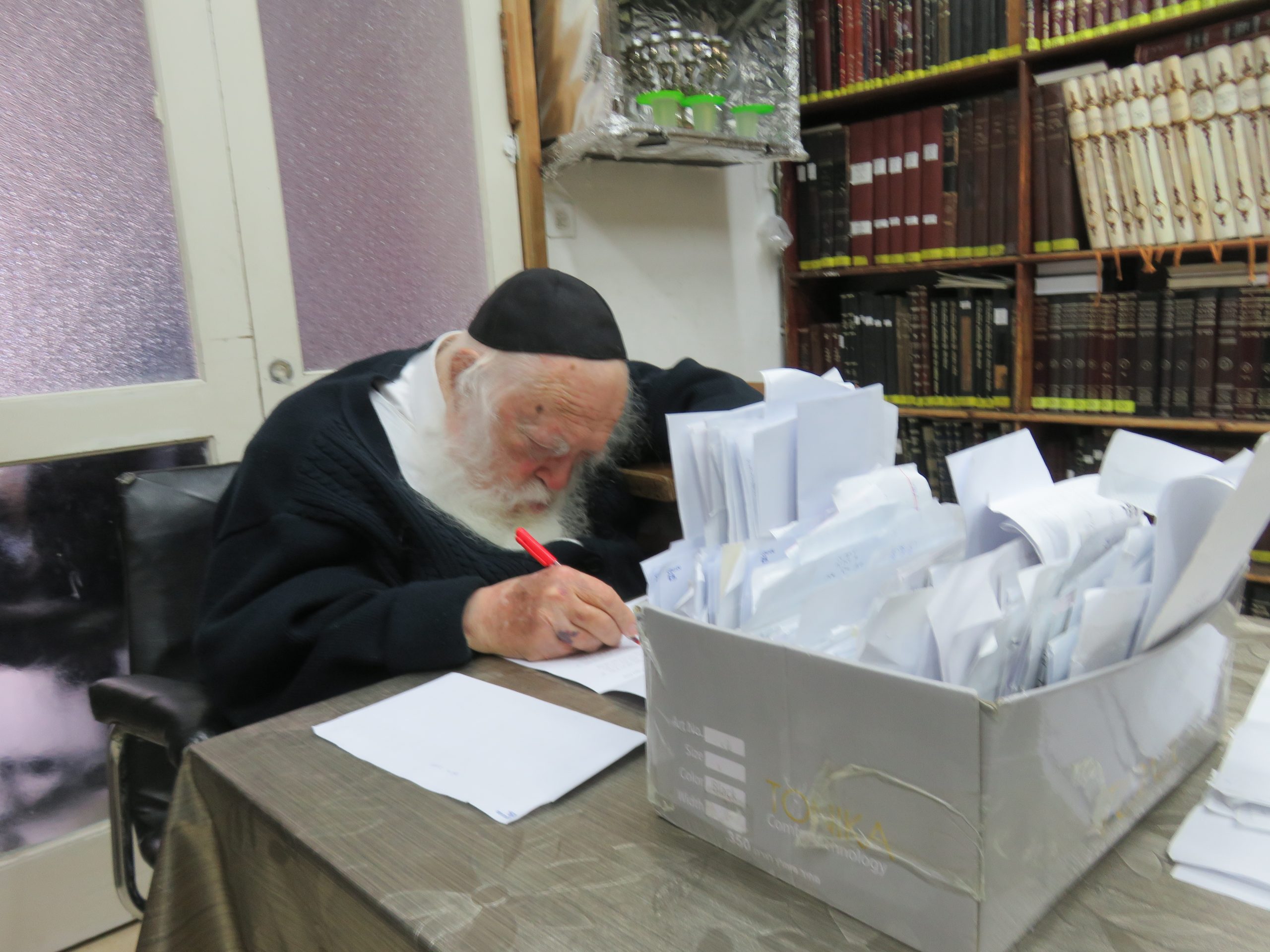
Since Rav Chaim first started sending shailos and teshuvos, he kept copies of everything. He made copies of the questions he asked himself, kept the questions he was sent, and saved a copy of the answers he gave.
The Steipler had a similar custom. In a letter to Rav Chaim Kreiswirth, he wrote that his divrei Torah are beloved to him and asks Rav Chaim hold onto the letter until he can pick it up or send him a photocopy, because he didn’t have a chance to make a copy on his own.
Rav Chaim had a few reasons for saving his letters: The sanctity of the divrei Torah in them; the import of the teshuvah; and so that the teshuvos could be compared to each other, since sometimes people asked the same question but received different answers based on their personal situations.
In addition, saving the teshuvah allowed Rav Chaim to look at the teshuvah again, if the questioner asked for further clarification.
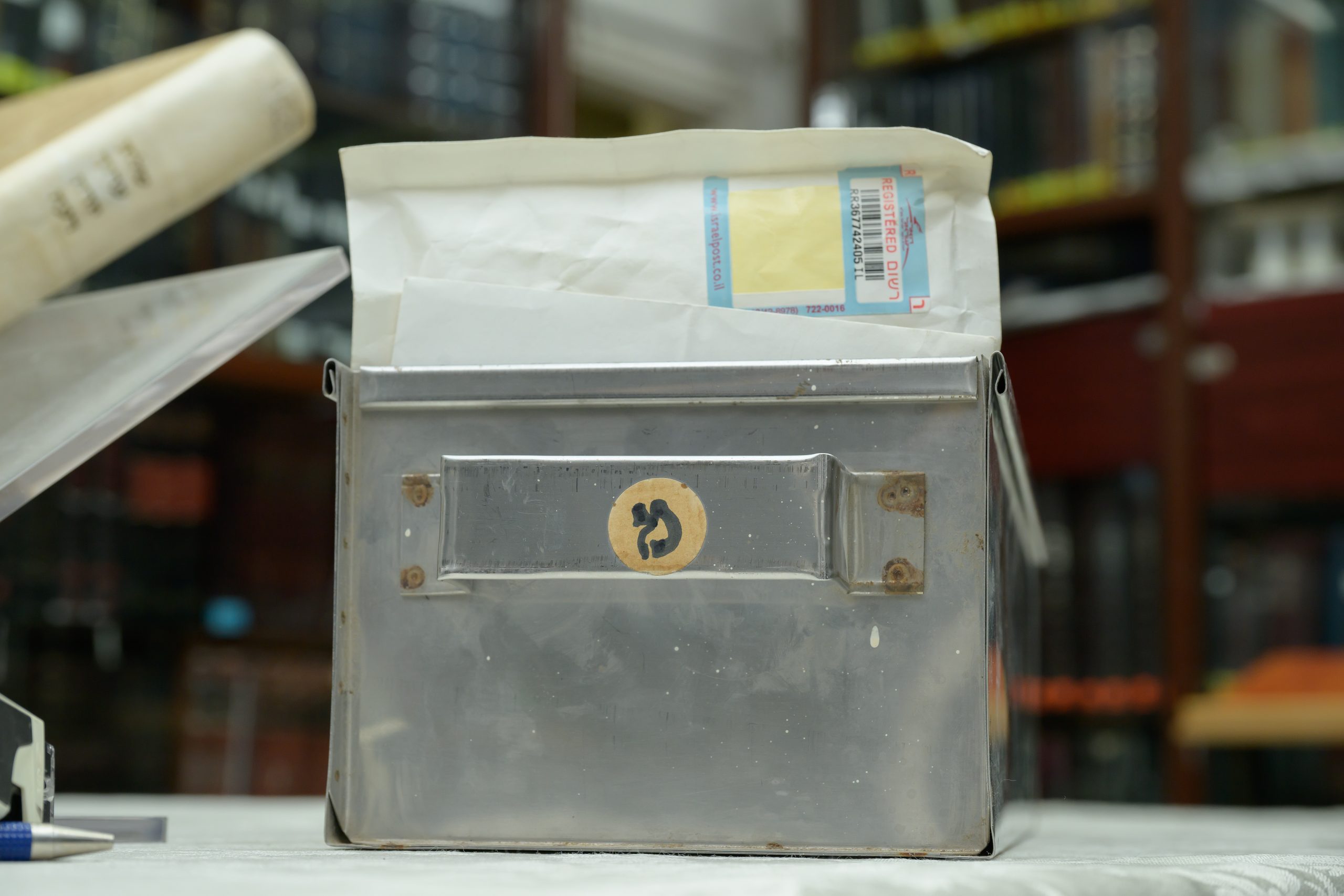
We look at the shelves, looseleaf after looseleaf, hundreds of them, full of treasures. Arranged in the order of the aleph-beis. In Rav Chaim’s house, you can still see the old, metal boxes with round stickers bearing aleph-beis letters, organized according to the name of the senders. For example, everyone whose name started with a מ were put into one box. But the amount of letters grew and multiplied. The stream of letters constantly increased.
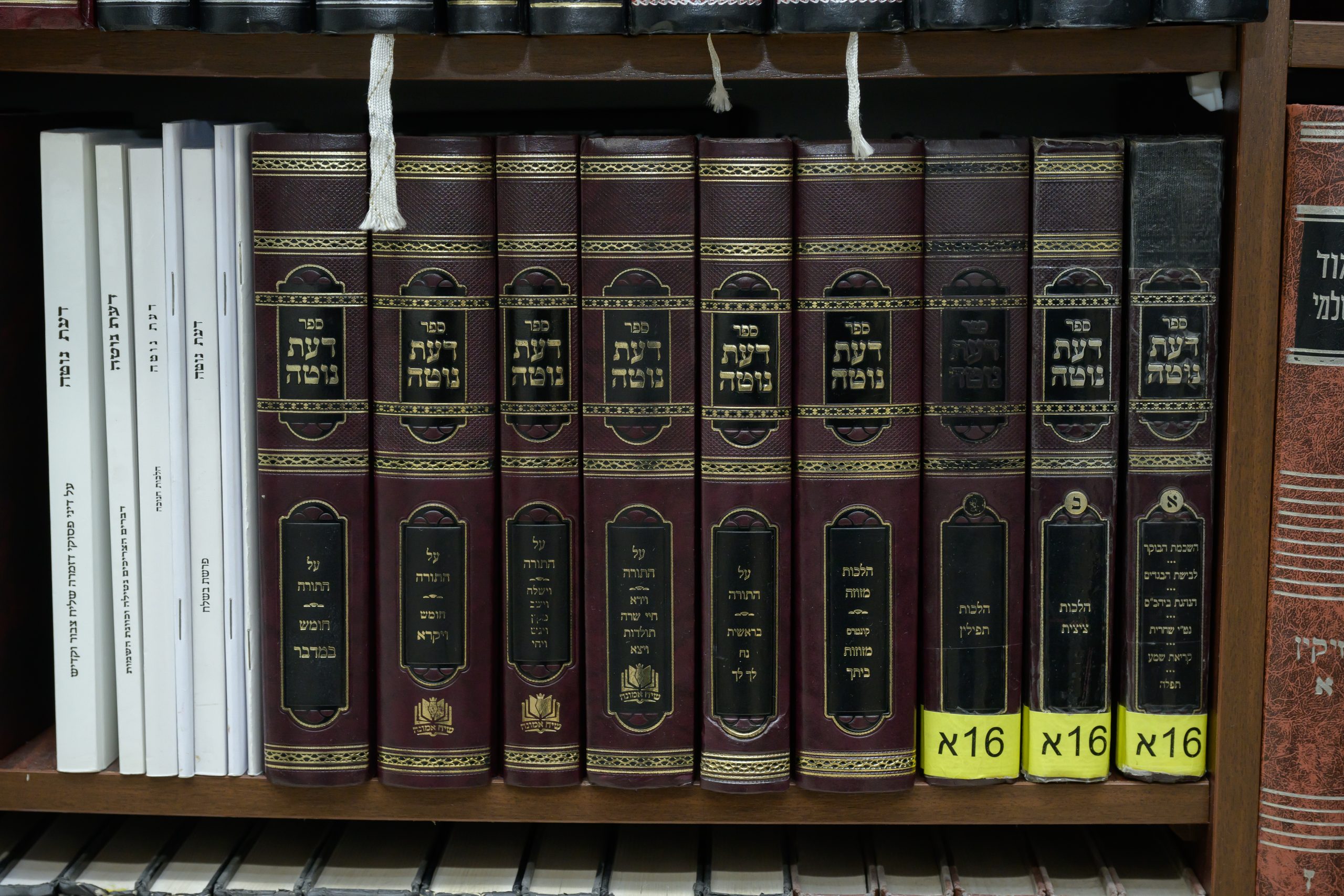
Today, there are already dozens of seforim based on Rav Chaim’s teshuvos, such as the shu”t of Rav Simcha Bunim Waldenberg zt”l, who collected letters in his Binas Simchah; and yibadel l’chaim tovim, Maran HaGaon HaRav Dov Landau, whose more than fifty years of correspondence turned into a sefer; or Teshuvah Mei’Ahavah, featuring correspondence beginning in 1959, between Rav Chaim and HaGaon Rav Avigdor Nebenzahl shlita, when they were still young avreichim in their twenties.
Some of the volumes in this treasury contains letters with identical answers, such as the thousands of letters that say תתפלל (daven), which was Rav Chaim standard answer to the many people who poured out their hearts and their troubles, including yeshivah bachurim who asked for advice regarding difficulties in yeshivah.
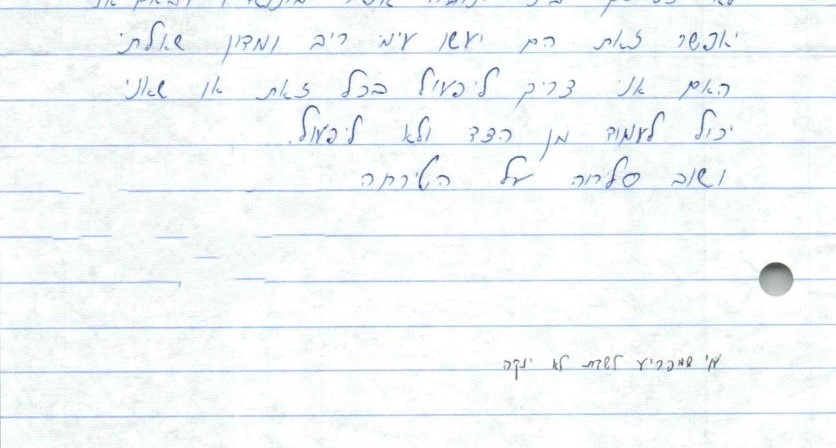
אני חייב בכפל is how Rav Chaim answered people who sent the same question more than once. Perhaps the writers hoped for a different answer, but they were astonished when Rav Chaim remembered that they had already asked the question.
Sometimes, when Yidden visited him for advice and a brachah, Rav Chaim recognized them based on letters they had sent. For instance, a person living on Mishmar HaGvul Street sent questions that Rav Chaim enjoyed. When he visited, Rav Chaim playfully said, “How were you able to leave the gvul (border) without a mishmar (guard)?”
“I don’t answer anonymous letters or post boxes,” is another answer that repeated itself. There were a few reasons for this response, including the content of the questions typically sent anonymously. Various questions regarding kedushah were generally answered with a standard response, “Refer to Karyana De’Igarta, volume 1, se’if 11-18.”
One looseleaf features the answers איני זוכר (I don’t remember), and another one contains letters that note שאלות אלו קשה לענות בכתב (it’s difficult to answer these types of question in writing). Various letters were answered with the initials פחמע”ד, in other words פוק חזי מאי עמא דבר – or כרצונך – do as you like.
Once the answer to someone who asked if he should get divorced was mistakenly switched. Rav Chaim had answered him כרצונו, do as you like. But someone asked for a source for the Chizkuni that an eved ivri who was given a shifcha kennanis should stay with his first wife, and Rav Chaim wrote that it was based on the Mechilita D’Rashbi אל תפרישנו מאשתו.
Rav Chaim realized the answers had been switched when a questioner asked for clarification. Rav Chaim explained that it was a mistake, but later said, “Maybe it happened min haShamayim so he wouldn’t divorce his wife.” When asked how come he hadn’t mentioned that to the questioner, Rav Chaim replied, “Do I know what goes on in Shamayim?”
Curt and Compassionate
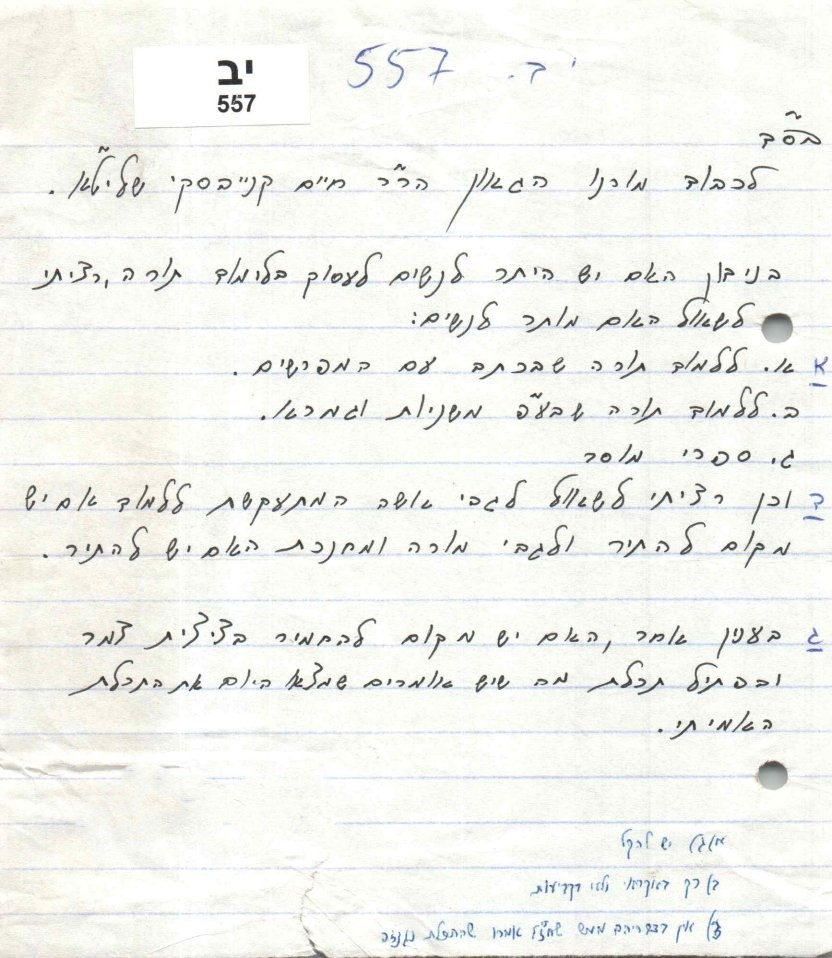
Before one of the grandsons starts pulling out interesting, rare letters that were not yet published on the subjects of our choice, we discern a volume of לא אוכל לענות על אלף שאלות מאפס פנאי (Due to time constraints, I can’t answer 1000 questions). This was Rav Chaim’s standard answer to letters featuring multiple questions. At times, Rav Chaim continued on and answered one question. He asked some people to limit themselves to three questions, quoting the Tosefta ולא ישאל השואל בענין יתיר משלש הלכות.
In contrast, some senders collected a number of questions and then sent them all at once, and Rav Chaim answered in great detail. There weren’t any clear rules regarding his answers. Sometimes he wrote in length, and sometimes very concisely. Though, it’s evident that when asked about the Chazon Ish, for example, he would often answer at length. Generally, he, of course, kept things as short and concise as possible.
One asker, a talmid chacham, was slightly insulted by the short answer he received. He protested in his next letter, claiming that the brevity didn’t express sufficient kavod haTorah. “How should I know if the writer is a child, older person or talmid chacham?” was Rav Chaim’s answer. He also noted that this time he would write a slightly longer answer.
The brief, concise style Rav Chaim adopted saved time and enabled him to answer so many questions. As the years passed, he received an average of 100 questions a day. What at first took a short amount of time after davening vasikin, became a much more significant part of his daily schedule that was already overfull with “chovos.”
When someone asked about the source for his brevity, Rav Chaim quoted the Rambam (perek beis, hilchos deios, halachah daled). “The same regarding words of Torah and wisdom, a person should use few words, with a lot of meaning. Our chachamim said that a person should always teach his talmidim short and to the point.”
In the work HaSeforim, Rav Chaim’s grandson, Rav Gedalia Honigsberg, says that Rav Chaim was asked about the disparity between his concise style when writing teshuvos and the lengthy details he writes in his seforim. Rav Chaim had explained that people who ask questions are well-versed in the subject they’re asking about and a short answer suffices. But when people learn from seforim, they need longer, more detailed explanations.
In general, the time that Rav Chaim dedicated to writing teshuvos definitely took a bite out of the time he set aside for writing or preparing his seforim for publication. At times, he limited the amount of teshuvos he answered a day, so as to allow for quicker progress on his seforim.
Rav Chaim labored over each and every one of his seforim, working diligently and quickly. He wrote each sefer three times, from the first sentence until the last one. First, he wrote a draft, then a complete, finished sefer, and then he wrote a corrected version for printing.
“Perhaps the Rav shouldn’t answer?” suggested someone who realized how much time it took Rav Chaim to answer his mail.
Rav Chaim gave him a look and said that though it was true that if he ignored the letters, he would print his seforim quicker, but the benefit of his teshuvos give them priority over his seforim. The letters encourage and gladden the receiver’s hearts, so writing them is chessed and chizzuk. Rav Chaim learned from his father that he should answer bnei Torah and encourage them, because it’s “impossible to know which zechus grants us existence.”
Another time, Rav Chaim said that since he isn’t a Rosh Yeshivah or maggid shiur, writing a lot of teshuvos was his harbatzas Torah. “It says that we need to answer every questioner,” he added.
When asked by a talmid how come he invests so much time in his teshuvos, he answered, “A pity on the letters, people want answers.”
How should Pharaoh know?
There were clear rules for opening the letters and answering them. First, letters written by women were removed from the pile and given to the Rebbetzin or, after her passing, to Rebbetzin Kolodetsky, Rav Chaim’s daughter. More than once, Rav Chaim’s ruach hakodesh led him to remove questions written by women that had inadvertently been included in his pile, without even first opening the envelopes.
Priority was first given to people living in Eretz Yisrael and then the letters would be arranged according to Kohen, Levi and Yisrael. Next came writers who shared a name with Rav Chaim’s father, Yaakov Yisrael. The rest of the letters were organized in the order in which they were received. By organizing the letters in this manner, something as physical and mundane as opening and answering letters was transformed into a holy task that was painstakingly carried out to align with Hashem’s will.
For many years, Rav Chaim himself walked over to the mailbox on Rashbam Street to mail his answers back to the senders.
Some people sent stamped reply envelopes along with their questions, while others sent questions on its own and received postcards in return. For many years, Rav Chaim wrote the answers by himself, including his name as the sender, but, later on, he stamped his last name as the sender.
Rav Chaim would often cut the last sentence of the question from the letter he received and insert it into the return envelope, but at times he wrote on a small piece of paper.
During his last two decades, after being partially paralyzed by a stroke, the doctors informed Rav Chaim that he would not be restored to complete health. They were absolutely certain that he would never write again. However, Maran Sar HaTorah, enlisting the power of his sanctity and resolve, refused to give up. Like a young child learning to write, he invested an inordinate amount of time and effort until he was able to produce a nice, clear script.
Though Rav Chaim won his battle and taught himself to write again, writing took much more time and effort. So, from then on, after he wrote a teshuvah on the page with the question that he kept for himself, his son copied the teshuvah over to be returned to the questioner.
Once, someone noticed Rav Chaim looking through the pile of envelopes, pulling out one of them and inserting a second envelope into it.
“Hashavas Aveidah,” he explained. “Sometimes people send a self-addressed stamped envelope. If they then send another question with a second stamped reply envelope, before I have a chance to answer the first one, I put the second stamped reply envelope together with the answer to the first question. It’s hashavas aveidah.”
The letters sent to him featured all different types of scripts and fonts. Some were even in a foreign language and a talmid would translate them for him. “Today, you have twenty goyim to be megayer,” Rav Chaim would tell the talmid with a smile, giving him the twenty letters to translate.
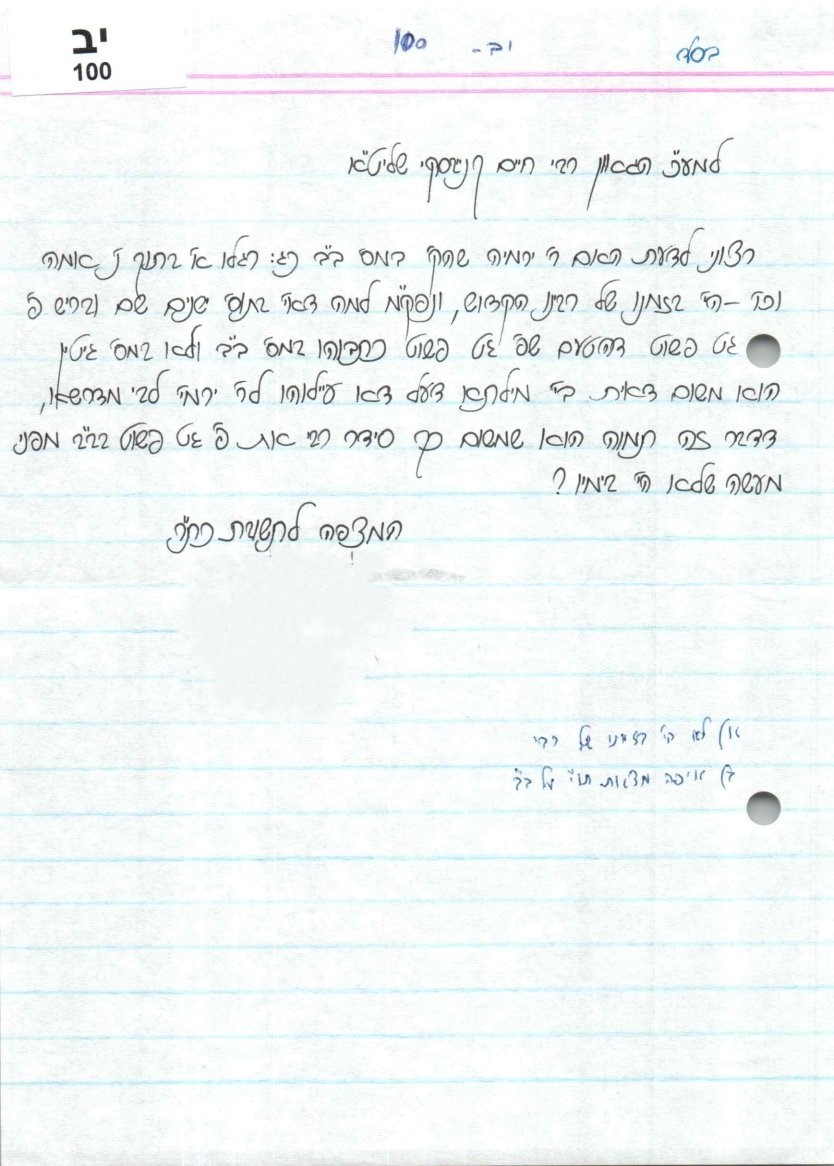
Every asker received an answer. Even very small children. Once, Rav Chaim sat for a long time with a question asked by a young boy. “In cheder, we learned in Parshas Miketz that Pharaoh dreamed that seven cows came out of the Yaor and then another set of seven. The pasuk says that the cows were אחריהן עולות. I asked my rebbe how come it saysאחריהן with aן and not with a ם, and he didn’t know the answer, so I’m asking the Rav.”
Rav Chaim said that he could explain the rules of dikduk, but the boy was probably too young to understand the answer. Rav Chaim’s son was there at the time and suggested that he should just put the letter on the side and leave it unanswered.
Rav Chaim answered emotionally, “I answer so many letters every day to give chizzuk to the letter writers, and I never know if they really get chizzuk from what I write. But a young child will definitely get chizzuk from the fact that someone took his question seriously.” And then, with a smile on his face, he wrote, “Pharaoh was in Mitzrayim and he didn’t know Hebrew.”
A questioner asked for advice on how to deal with a son who talks a lot on the telephone. Rav Chaim answered לנ”א ולבנ”א. When the questioner sent another letter asking for an explanation, Rav Chaim wrote that he used the initials even though he realized they wouldn’t be understood, because the question itself was unclear. What does the boy talk about? How should Rav Chaim know? לא נביא אני ולא בן נביא אנוכי, I’m not a navi or the son of a navi!
At times, it took time to write halachic teshuvos. A grandson asked how he could answer dozens of letters very quickly and then spend a whole day answering one letter. Rav Chaim answered that difficulty isn’t measured in time. “I’m fearful of making a mistake in halachah. I don’t want to make a mistake and make others make mistakes.” He added, “And it’s not difficult to toil on this a whole day.”
Rav Chaim would always emphasize in his seforim and, at times, in his letters, that his teshuvos shouldn’t be relied on for halachah l’maaseh.
@”No shortage of rabbanim.”
One night, Rav Chaim suddenly woke up after two hours of sleep and asked, “Where are the letters?”
His family tried to figure out what letters he was referring to. “I just answered a big pile of divrei Torah,” he used two hands to show them the size of the pile. “Where is it?”
Even while he slept, Rav Chaim dreamt about writing his letters!
We’re just about ready to view a bunch of exciting discoveries. Actually, there is no topic that isn’t discussed in Rav Chaim’s own hand in this treasury. (For the most part, the original teshuvah written by Rav Chaim is preserved in these looseleafs and the asker received a copy written over by Rav Chaim’s son.)
Amongst the many letters, there is some correspondence with Gedolei Yisrael, including some written when Rav Chaim was a bachur. In one fascinating letter, Rav Chaim’s father-in-law, Maran Posek Hador HaRav Yosef Shalom Elyashiv tells him that he finds himself on erev Sukkos without a mehudar esrog.
Rav Chaim was apparently a young avreich when the letter was written, after the birth of his first daughter, Rebbetzin Chana Steinman a”h, since Rav Elyashiv only mentions one granddaughter. The letter was apparently written over 70 years ago, during the Aseres Yimei Teshuvah of 5713/1953.
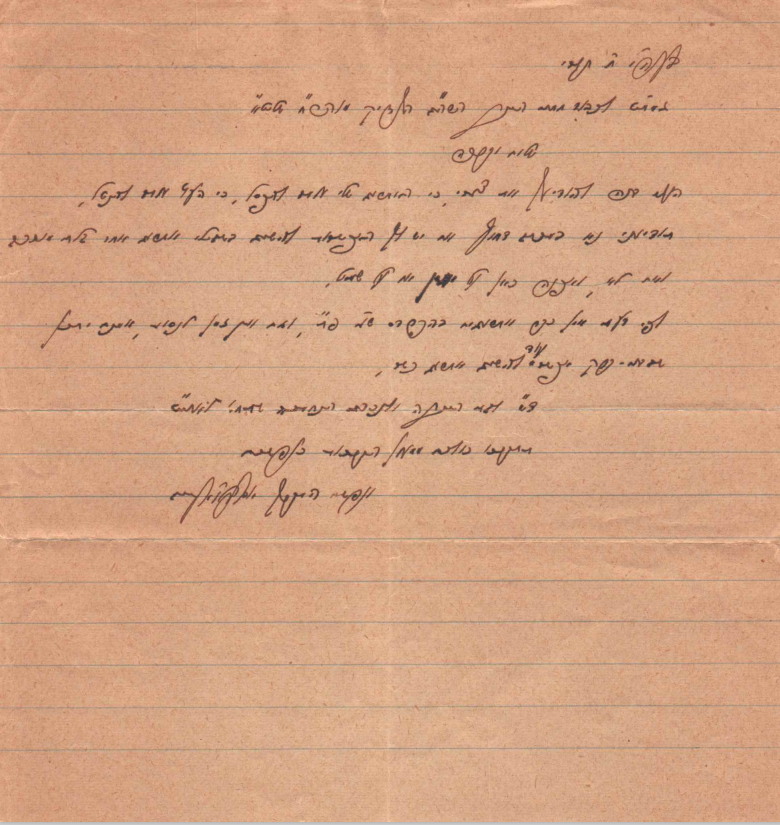
Bezras Hashem, 18th of Tishrei
Gemar Chasimah Tova to my dear son-in-law ….HaTazaddik…..Rav Chaim shlita
Shalom U’Vrachah. Unfortunately, my esrog is becoming pasul, since …. Please let me know in an urgent letter if you can procure a different ungrafted esrog for me. If not, I will look wherever I can for another one.
I believe that there are no more esrogim with the ש”מ פ”ת hechsher and there is also no time for a trip there, but perhaps in Bnei Brak it’s still possible to obtain a kosher esrog.
Regards to my dear daughter and my sweet granddaughter shetichyeh l’orech yamim tovim.
May you all be blessed from the Ba’al HaBrachos.
Yosef Shalom Elyashiv
Yes, there was a time when Maran HaGaon Rav Yosef Shalom didn’t have an esrog, and his son-in-law tried getting one for him.
Another fascinating exchange took place between Rav Chaim and HaGaon HaRav Chaim Greineman, back when he lived in Yerushalayim. These letters clearly indicate that Rav Chaim wrote in length when it came to stories related to the Chazon Ish.
For example, in a letter dated 5,715/1955 sent by “Dov Landau, PO Box 21, Bnei Brak,” Rav Dov asks a few questions, and relates that he heard from someone close to the Chazon Ish that, “in recent years, there is a concern about making havdalah on beer on motzei Pesach.”
In his response that opens, “My friend, HaRav HaGaon, HaMitzuyan….Dov shlita, Rav Chaim writes, “I heard that Maran Chazon Ish recently said that it isn’t chamar medinah today (I never saw people make havdalah on beer on motzei Pesach, perhaps they do so in chutz la’aretz”).
Leafing through the letters, we journey through the generations. But, of course, sensitive questions or ones containing personal information were never shown to anyone, other than someone who Rav Chaim himself trusted. Though we have a free hand to look through these looseleafs, they were organized so that we wouldn’t see anything that might make the letter writer uncomfortable, and the names of the askers are covered.
In a letter from Elul 5758/1998, someone asks for marei mekomos from throughout the Torah. Rav Chaim’s response is a fascinating witness to the scope of his fluency in Torah. As a source for the fact that the geulah won’t arrive until the tears that Eisav cried will be finished, he wrote, “Zohar HaKadosh, Shemos 12:2″. To answer the question, “Who is the redeemer Dovid or his progeny?” Rav Chaim referenced Zohar Hakodesh Lech Perek 2:2.
His candid and forthright character peeps through in a teshuvah he sent to someone teaching in a yeshivah for baalei teshuvah in Yerushalayim. The writer added a parenthetical question regarding photocopying a large part of a sefer. He wants to print the Iter Yad kuntress that is printed at the end of Rav Chaim’s Masechet Tefillin and distribute it to the baalei teshuvah he teaches. “It will be mezakeh the rabbim, and it’s very necessary for lefties, especially for those who don’t know how to look up the halachos on their own…”
Rav Chaim wrote this kuntress, a compilation of halachos related to lefties, as a gift to his father, the Steipler, who was a leftie. Rav Chaim used the modest profits earned by selling his seforim to support his family.
“I think that will be a loss for me,” Rav Chaim answered. “A lot of people buy the whole sefer for the kuntress at its end.”
Another letter contained a “burning” question: The gemara states that one who denigrates talmidei chachamim is an apikores. What about a newspaper that denigrates talmidei chachamim? Is it considered sifrei minim? The questioner then continued to another question. Can an apikores who denigrates talmidei chachamim be motzi someone else in kiddush? Apparently, Rav Chaim sensed the story hidden between the lines.
“I’m not a posek,” he responded. “There’s no shortage of rabbanim in Yerushalayim.”
A group of seventeen-year-old bachurim in a yeshivah in France complained about the hespek in their yeshivah, claiming that the rabbanim were refusing to make certain changes that would give them sipuk in learning. They asked Rav Chaim, “To please give da’as Torah on the subject.”
The response they merited was typical of Rav Chaim’s approach to these types of questions. “The rabbanim in the yeshivah probably have a much better understanding than the talmidim.” A bachur in Yeshivas Chevron posed a question about the derech halimmud in his yeshivah. Rav Chaim’s answer: “Speak to your mashgiach.”
One letter was written during the early days of the Ateres Shlomo institutions. The question was written in a very young script.
B’Siyata Dishmaya, 8th of Sivan. L’Kesser Torah HaGaon HaGadol Rav Chaim Kanievsky shlita.
My yeshivah friends and I don’t know if we should arrange chavrusas as early as possible, even a few zmans in advance. There are some disadvantages to that approach, but since some bachurim do arrange chavrusas early, the rest of the bachurim are pressured to also hurry. Or should we make a chavrusa a week or two before bein hazemanim? I am asking on behalf of the bachurim, what we should do?
Talmid in Ohr Eliezer Beit Shemesh
Rav Chaim answered with two words: תפנה לרבותיך (ask your rabbanim).
Rav Chaim wisely avoiding answering questions that were essentially an attempt to elicit an answer different than the asker’s rabbanim or ones related to any type of machlokes.
Esrogim and Bikes
“My son’s bike was stolen,” an avreich shares after writing his question in limmud. “He wants a new one so he can get to masmidim quickly etc.… The subject has triggered a lot of worrying thoughts about things that could chas v’shalom happen to him while he rides his bike. Are these worries legitimate?”
Rav Chaim’s answer came from a different direction. “It’s not good for a child to get used to a bike.”
Yes, even the question about a boy and his stolen bike reached the desk of the Sar HaTorah.
There is an amazing variety and quantity of questions. One averich asked if he should tell his parents and in-laws that they are expecting a child. After all, brachah rests on “things hidden from the eye.” Rav Chaim answered resolutely, “You definitely need to tell them.”
A parent asked for advice about his seven-year-old-son who used to excel in school, but has been misbehaving, daydreaming, and unmotivated since Pesach. The parent wants to know, “What can be done to save the situation?” Rav Chaim’s answer: “Perhaps he ate something assur.”
A young yeshivah bachur wanted to know if he could grow short bangs and if it was permissible to trim his beard to honor his parents. “Chalilah to grow bangs,” Rav Chaim answered. “And it’s improper to trim your beard.”
One lengthy question was presented as a machlokes between Rav Chaim and his father-in-law Rav Elyashiv regarding drinking wine every day of Chol Hamoed.
Rav Chaim answered, “Since Mori V’Chami shlita answered the question, I withdraw my opinion and it makes no difference.”
A bachur who was a kohen asks if he starts Shemoneh Esrei with the chazan, should he say kedushah with him, which would mean missing Birkas Kohanim, or should he continue without Kedushah to be able to say Birkas Kohanim. “I asked the Chazon Ish,” Rav Chaim answered in his teshuvah, “if I’m allowed to say “Shalom Rav” in the morning, in order to be able to say Kedushah and he said that it’s assur. That’s very similar to your question.”
At this opportunity, the questioner mentions that the sefer Shekel HaKodesh motivates him to learn the hilchos of kiddush hachodesh. “It would be wonderful if there was a shiur I could attend on these subjects.”
Rav Chaim answers, “I tried to make the biur clear enough to give people the option of learning these subjects on their own.”
What is the halachah, someone clarified, about an avreich who does unnecessary renovations to his home? Can we give him maaser money? The writer’s disproval of the avreich’s standard of living is clear in his delineation of the necessary renovations and superfluous ones.
Maran answered sharply and meaningfully, “Dai machsoro asher yechsar lo..”
We looked for a teshuvah regarding ticheles. Many people wanted to hear Rav Chaim’s opinion on the subject. Once, in a recorded session, he told a questioner that ticheles was nignaz. The questioner wasn’t satisfied and stubbornly insisted that he has proof that the original ticheles was found. Rav Chaim said that he is mechuyev in ticheles and added with a smile that he should be motzi him too. When asked for an explanation, Rav Chaim answered, “If you’re sure that you know, then you’re chayav.”
So, what was Rav Chaim’s opinion on ticheles?
An avreich asked if he should be machmir with ticheles now that some claim that the authentic ticheles has been rediscovered. Rav Chaim answered, “There is no substance to their words, since Chazal said that ticheles was nignaz.”
He answered that a woman who insists on learning Torah Sheba’al Peh, “should only learn on occasion and not on a regular basis.”
What about neighbors who oppose putting an electric wire on the building’s roof for a Shabbos generator. Should the other neighbors push forward with the generator if it would cause a fight? Rav Chaim’s answer was chilling, “One who bothers Shabbos, will not be cleansed.”
In the earlier years, a letter writer discusses the polemic regarding the Sefer HaEshkol written by the Raavad II that was published by Rav Hirsch Wolf Auerbach, a German rav. The publisher of another, later edition claimed that the first edition contained many forgeries, leading to additional polemics. “Rav Auerbach was a great man, and he would never lie,” was Rav Chaim’s answer. (Parenthetically, someone later proved that the texts Rav Auerbach published were all authentic, but someone else printed additional things in his name, and it was these supplements that were suspect.)
Someone asked a question regarding old Tosfos on Bava Basra, in the days before newer editions were printed. Rav Chaim immediately answered with a question: Where did you find old Tosfos on Bava Basra?
“What was the shitah of Maran Chazon Ish regarding Mussar?” a yeshivah bachur asked. “Everyone thinks that he opposed learning mussar. Is that true, in what details, and why?”
Rav Chaim’s two- word answer: שקר וכזב — lies and untruth.
Someone apparently said that Rav Chaim’s chavrusa had related that dozens of years earlier, when they learned in Kollel Chazon Ish, Rav Chaim had said that it was possible to locate the place of the mizbeach. Now a letter writer wants to know, “Please explain in short, where is the location of the mizbeach?”
If you’re curious about Rav Chaim’s opinion regarding the location of the mizbeach, his answer is exceedingly simple:
“If the makom habayis is known according to the even hashisyah, you can clarify the location of the mizbeach according to the Rambam, perek 5 of hilchos beis habechirah.”
One questioner told over a story he heard about the Chazon Ish and asked if the story actually happened along with its halachic ramifications. As the story went, the Chazon Ish did the mitzvah of shiluach haken with a nest in Kollel Chazon Ish, and was then mafkir the eggs so that additional avreichim could fulfill the mitzvah. According to the questioner, the happy ending to the story was that all those avreichim had sons.
The answer he received was amazing. “The story happened to me,” Rav Chaim wrote, possibly meaning that the story happened in his house, and not in Kollel Chazon Ish, because according to the detail of the story, Rav Chaim couldn’t have been one of the avreichim. Even though …and, apparently, Rav Meir Arik z”l disagree, most Achronim agree that…one can be mafkir.”
In answer to a request for a segulah for yiras Shamayim, Rav Chaim suggested learning Seder Teharos.
A Rosh Kollel looking for a way to cover his financial obligations wonders about the advisability of making lachashim discussed in seforim (incantations) to remove ayin hara from Jews. He asks if there’s a danger in dealing with these types of things, and if there a specific lachash that Rav Chaim recommends.
“Lachashim that don’t have angel swearing and the like” Rav Chaim answers, “are only tefillos to Hashem and there is nothing dangerous about them.”
@@
Letters are quickly pulled out for us from all different looseleafs, revealing rich, diverse worlds in Rav Chaim’s teshuvos and da’as Torah. It seems absolutely impossible that the Torah giant who was so completely invested in his Torah study, wrote these hundreds of thousands of letters, with careful attention, caring, and warmth. For each and every person of any age and in every location.
The young child who davened and dreamed of writing; the bachur, the masmid, who looked at the world and chose to sit and learn; who became Maran Sar HaTorah with his many chovos in Torah, didn’t stop writing these letters until his very last days. Here is his legacy, an unbelievable harvest, a treasury of unimaginable scope.
He organized teshuvah after teshuvah, subject after subject, with dedication, precision and with inestimable ahavas Torah. One day, after volume after volume is published, entire bookshelves will be filled with his treasures that will influence the entire world. Already now there are shelves of seforim compiled from his teshuvos.
We can stand for hours over here, just looking at this intoxicating sight.

Eitz HaDaas
We look at the tenth volume of the Daas Noteh series— the first volume of this series was published when Rav Chaim was still alive and featured teshuvos related to the halachos of hashkamas haboker, netilas yadayim, Shacharis etc.., compiled from “only” 70,000 letters. The name of this series is based on the gemara in Chulin that asks if the words of Rav Yehuda is daas Torah or daas noteh. The title expresses Rav Chaim’s humility and belief that his teshuvos aren’t daas Torah but daas noteh.
This tenth volume, that still smells of the printing press, discusses Megillas Esther. It contains hundreds of pages with teshuvos to all different types of questions. Some of the questions have a number of teshuvos, per the different answers that Rav Chaim gave to different people who asked the same question. Sometimes he used different styles, always making sure to match the subject and the questioner. The teshuvos are quoted with many added marei mekomos and discussions.
“Even though I am not worthy of hora’ah,” Rav Chaim wrote in his introduction to the first volume, “I answer them to give chizzuk, but I always caution that my teshuvos are not to be relied upon for practical application. L’maaseh, if they can, they should look into the subject on their own or ask a Chacham who is worthy of hora’ah. Recently, I have seen that many of my teshuvos were printed, though I asked them to write not to rely on them l’maaseh, and this could, chas v’shalom cause a mishap. My son HaRav Yitzchak Shaul shlita suggested giving the teshuvos to a number of talmidei chachamim to review and to include their comments….”
Rav Chaim’s vision was fulfilled. He saved all the letters that he wrote! At times, the askers themselves, talmidei chachamim who published the shu”t together with him, were amazed at the fact that what they had lost over the years, still remains, as if had just been written that day.
The hundreds of seforim featuring teshuvos he wrote to different questioners indicate how far he could see into the distance and emphasize the magnitude of these teshuvos that he wrote with dedication and precision every single day.
Limited Comprehension
On motzei Shabbos after the shock, before anybody could fully grasp that they were now living in new times, in a world “without Rav Chaim,” the children sit around piles of seforim that had been purchased over the years at 23 Rashbam Street.